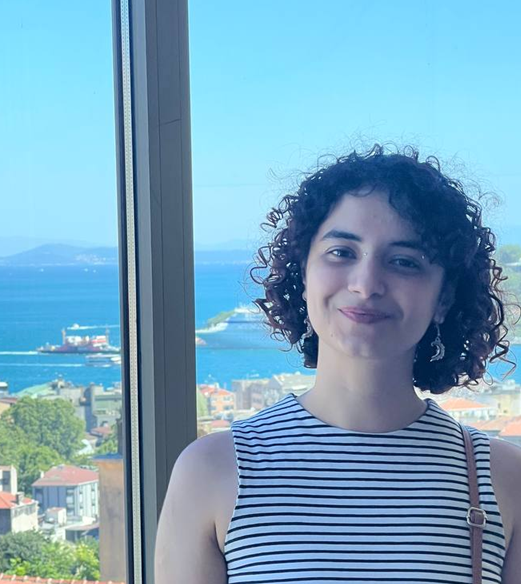
I'm an MSc student in Computer Science (minor in Neuro-X) at EPFL, where I'm a Research Assistant at VILAB and the NeuroAI Lab, co-advised by Prof. Amir Zamir and Prof. Martin Schrimpf. I'm broadly interested in efficient generative methods for probing the brain as a black box: modelling what a region responds to, generating the stimuli that drive it, and personalizing that to an individual brain in-vivo. Currently I'm working on closed-loop stimulus optimization, and on whether designed sensory input can steer a target region, with a goal of therapeutic non-invasive neuromodulation. I also love creative coding and shaders, and I consider their potential as stimuli for neurofeedback and therapeutic setups. Previously I was a research intern at VILAB through two Summer@EPFL programs, where I worked on visual personalization of generative models, and I worked as an AI engineer at Vitruvian Shield, a digital healthcare startup, where I built models that detect health anomalies from wearable biosignals such as PPG.

Sogand Salehi

Research

Selected Work

Generative models for probing the brain, closed-loop neural optimization, and visual personalization.

NEvo

NEvo: Neural-Guided Video Synthesis for Probing Dynamic Visual Selectivity

Y. Tang*, S. Salehi*, M. Zhou*, A. Zamir, L. Isik, M. Schrimpf

Neural Information Processing Systems (NeurIPS), 2026   · project page

Brain encoding models can synthesize the stimuli that best drive a given region, but prior work stopped at static images. NEvo extends this to video: an evolutionary search over a structured prompt space, guided by a dynamic encoding model, discovers videos that hyper-activate a target ROI. We use it to probe how selectivity for temporal and social-dynamic features is organized across the visual pathways, including with abstract, non-naturalistic stimuli, giving an in-silico route to predictions for in-vivo experiments.

CLoNeD

CLoNeD: Closed-Loop Visual Neuromodulation under Neural Drift

S. Salehi, E. Amari-Milliti, F. Déjean, M. Grudzien

CS-503 EPFL, 2026   · project page

Closed-loop stimulus optimization searches for the image that maximally drives a brain region from scalar neural feedback alone. Existing methods assume the target stays fixed, but real neural responses drift within minutes from fatigue, habituation, and shifting attention, and the algorithm never learns that a shift occurred. We study when accounting for this drift actually helps, and introduce an adaptive controller that infers the drift regime from the reward signal alone.

ViPer

ViPer: Visual Personalization of Generative Models via Individual Preference Learning

S. Salehi, M. Shafiei, T. Yeo, R. Bachmann, A. Zamir

European Conference on Computer Vision (ECCV), 2024   · project page & demo

The same prompt pleases different people differently, yet text-to-image models are tuned for a broad average, leaving users to do tedious prompt engineering to get what they actually want. ViPer captures a user's visual preference once, from a few comments on why they like or dislike a small set of images, and uses a vision-language model to extract their liked and disliked attributes. These then steer generation toward that individual.